
Boxy
https://yippeefish.itch.io/boxy
7 Jan 2026 - 3 Feb 2026
Sheridan College Institute of Technology and Advanced Learning
Boxy is a 3D platforming game I had as an assignment in my second year in the Game Design program at Sheridan.
Boxy involved downloading a provided toolkit which included a character controller, enemies, hazards, moving platforms, throwable and pushable crates, coins, and checkpoints.
I was given the task of teaching, testing, and challenging the player with every component in the toolkit in one continuous level, the player having a beginner to intermediate skill level, and already knows the controls.

Map Overview
I created an overview of the level, which included general ideas on what kinds of challenges would be happening and when they would be happening in the level.
I split the level into 17 sections for easier planning and modifying, and annotated in purple boxes wherever I saw fit to better understand and explain my though process.
This served as a key guideline for how the level's beats will be played by and presented to the player.

Bubble Diagram
I created a bubble diagram to map out when the level's beats will occur in the level.
This followed the flow of teaching, testing, and challenging the player the farther they progress, but also keeping some lighter sections near the end to give the player some areas to rest.
This bubble diagram informed me how I would design the different sections in the map overview.

Map Layout
I made a map layout as I was making the map overview to get a better sense of the space each section would be taking compared to one another.
I gave the player two paths which they can follow: The longer and easier path, and the harder but faster route.
The map layout helped a lot with connecting the paths back at the ending section.
My original iteration of the level was very noisy due to many sections being able to be seen all at once, so I gave myself a rule to only have up to three sections visible at any given time, where I would use turns, elevation, and smaller openings to separate the sections.
This led to a more controlled and easier to learn and understand level.

Difficulty Map
I created this map to have a better understanding on what the level would look like in terms of difficulty over time so I can give the player a proper ramp up in challenge over time, and some breaks between more challenging sections.
I used the different difficulties from the bubble diagram to determine which section would receive which difficulty.
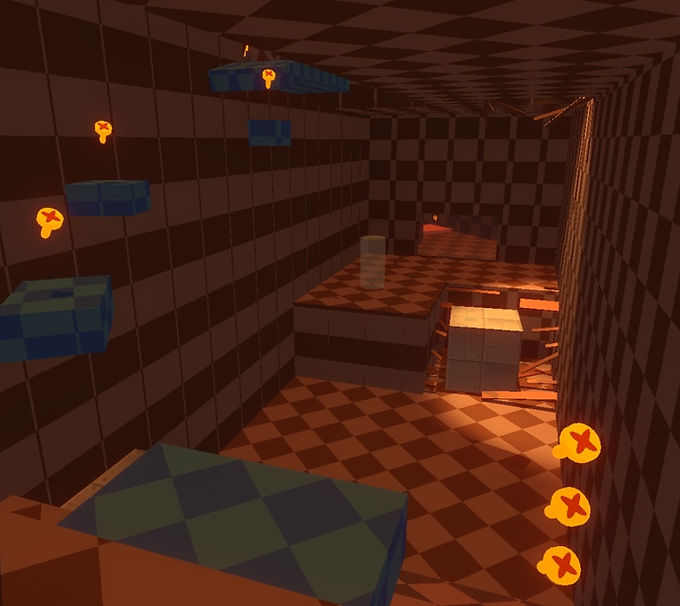
Section 4
The path splits here, with the easier but longer path at the bottom, and the harder but more challenging path upwards.
I display to the player that the easier path will be the one downwards by starting the section in a small hallway, leaving only the lit up box and three coins guiding downwards in view. Once the player gets closer, there is an angled corner to the left to make the platforms easier to see, but it's darker, the jumps are smaller than what the player has seen up to this point, and the opening has some sharp, triangular shapes in the frame, signifying danger.

Section 10
The room is lit with a strong blue at the very back where the end goal of the game lies, with the shadows guiding the player's view towards the goal.
The section the goal is located in is elevated, marking its importance, but is also blocked behind a grate, signifying that there is some challenge to pass before the player is able to reach the goal.
There are multiple locations the player can move to to obtain more coins, but each of those areas pose a small threat with enemies nearby.
The box pulling component builds off of the box pulling from section 4, however this time, the player also needs to account for enemies and hazards blocking the path.

Old Map Overview
This is the original map overview I made.
I was originally more focused on making everything in the level as believable as possible, however it was to the point of it harming the overall product as there were many aspects I wasn't able to add in.
Additionally, the layout of the map caused the screen to get noisy with many sections of the level all being on screen at the same time.
I ended up pivoting from this map, but kept part of the ending section of the main floor, and the weaving through the hazards at the bottom right of the lower area as I found those aspects to be enjoyable.

Old Bubble Diagram
This is the original bubble diagram I had made. It had multiple sections where it would temporarily split off, giving the player some agency on how they would beat the level.
I recognized that this was missing some needed beats, and could have some better structure, so I ended up remaking the bubble diagram later, while keeping note of some parts I liked.

Old Map Layout
This is the original map layout. I used this to get a better understanding of how much of the level the player would be able to see at any given time, and noticed that some sections were very straight, which led to a somewhat bland view for the player.
I learned from this and added twists and turns when separating sections of my level.

Player metrics
I made a sandbox level where I could find the character's movement and jump height, and found a jump height of 3, and a jump distance of 8.
I used this to better inform myself on the dimensions of the level as I was building it
To test the jump height, I paused once the player hit the maximum height the jump would allow, and drew some notes from there.
To test the jump distance, I repeatedly jumped across a gap, changing its distance slightly to see what felt most comfortable.
A jump distance of 8 will leave the player enough room to comfortably land rather than being on the edge.